12/6/09

November 17 – Luang Prabang, Laos


Our local bus journey from Luang Namtha to Luang Prabang was comfortable, long but comfortable. And most importantly, uneventful. No chickens but lots of locals and bags of rice. However, we all had seats to ourselves and the a/c worked. Aside from a long tuktuk ride with a driver who spoke no English and clearly had no idea where our guesthouse was, we finally arrived to Xieng Mouane Guest House. We chalked it up to a unplanned city tour…in the dark.

We instantly loved Luang Prabang. Its narrow streets, funky cafes, French inspired architecture and obvious history lured us in right away. Picking accommodation from afar (thank you Ron again and again for all the endless hours of research to find our next bed) is hard and time consuming, basing decisions on travel site reviews and bad maps. There is always a collective sigh of relief when we arrive, all the stars line up and we find the character, price, cleanliness and location are all up to snuff. Xieng Mouane Guest House is a short walk from the centre of Old Luang Prabang (where you want to be), close to the river, on the morning monk route and relatively quiet. We had the suite on the first floor with two rooms, unbelievably high ceilings, narrow doors leading out to the street and garden and private bathroom.

We ended up staying for 4 nights. A welcome length of time after lots of moving. Highlights during our 3 full days included; visitng the Wat Sieng Thong temple, cruising the Night Market, enjoying a bottle of wine (something we had not had or seen for months) and eating at the corner crepe and juice bar steps away from our guest house. Janet, having a nose for finding coffee, found a great brew at the Scandinavian Bakery which she trotted to every morning before breakfast. Marge (her mom) would have been proud. Our transportation of choice was bicycle and motorcycle.


We rented motorbikes one day and headed about 32 km to find the Tat Kuang Si Waterfall. We had been warned by local tuktuk drivers the road is dangerous. We decided to check it out and turn back if it felt wrong. We felt we had the road to ourselves, it was paved the whole way with gentle curves. No problem. Sometimes it’s hard to know who is giving you an honest warning and who is just trying to sell you. Not to mention the juggle of deciding what is the safest choice, especially with kids, given you are in a foreign country with a completely different set of standards. Remember, entire families of up to five or six will pile on their motorcycles and head from A to B. The road took us through villages and seemingly endless fields of rubber trees, teak forests and rice patties. Janet is getting quite excited about her new talents as a motorcycle driver (ok, It’s almost a scooter) and dreaming of trading in the Honda Odyssey for a Honda 125 with a basket on the front.


The waterfalls did not disappoint. There are numerous levels of turquoise coloured pools all connected by pretty little waterfalls. The largest waterfall is at the top and falls about 250 feet. We hiked up to the very top on the right side which was a bit steep and slippery for flip flops. At the top you can walk right across the falls looking back down to the first pool. There is a much better descent down the other side (which you can use to go up too if you figure it out quicker than we did) taking you back down to the various pools accessible for swimming. The best pool was the second one with a 12 foot waterfall we could jump off and a fabulous rope swing off a tree hanging over the pool. Yes, we all jumped and swung till we were water logged. It is definitely the backpackers scene in the pools and the later you go, the more crowded it gets. Just outside the park gates there was a number of food stalls offering everything from grilled fish, noodles or rice to baguette sandwiches.


The other cool thing about Luang Prabang is the daily ritual where the monks collect food from locals and tourists. They have a specific route and starting at about 6 am they depart from their monasteries to walk the route to collect their “daily bread” or rice, nuts, fruit etc. This is the only food they get for the day. By 6:30am the trail of monks dressed in their orange robes is as far as you can see down the street. They walk along in bare feet carrying a metal bowl strapped to their shoulders. The locals and participating tourists kneel on straw mats along the edge of the street and pass out food to every monk, without looking up at them. It is fascinating to watch and worth the early rise.


On our other full day we rented bicycles and toured around. The girls are fabulous now at navigating traffic on these big city bikes. We got caught in the rain but even that did not deter us from backtracking at the end to find the Jo Ma bakery with cappuccino and chocolate chip cookies to die for. We ventured across the river to the weaving and paper handicraft village called Xang Kong. The roads became pretty marginal and hilarious to navigate on our one gear bikes. Just when we thought we had officially entered “deliverance country” the village we had been aiming for came into view.


All in all, Luang Prabang was one of our highlights. Sometimes you can’t explain exactly why certain places stand out. Mmaybe it’s just the feel of a place or the mood of the traveler or a great combination of both.

November 13 – Huay Xai & Luang Namtha, Laos

We had our first mini-van travel experience from Chiang Mai up to Chiang Khong at the border of Thailand and Laos. Mini-Vans seem to be the predominant mode of travel in Thailand and Laos for travelers who are not flying and are not taking the bus. Most guest houses can find you a seat in one going to most destinations along the beaten path. Our trip was about six hours long and a little rough for us in the back. It was jammed with 9 passengers. Regardless, we got to Chiang Khong in time (and with lurching stomachs) to take a “ferry” across the Mekong River to Huay Xai in Laos.

Our border experience was completely smooth although I think we just beat the afternoon rush. And the words ferry and border did not quite muster up a realistic picture of what we experienced. Our “ferry” was a long, shallow traditional style Laos river boat with plank seats. The Mekong River at Chiang Khong/Huay Xai is quite narrow and took a couple of minutes to cross. The “border” consisted of a small office where we purchased our entry visas (don’t be fooled if travelling here and told you are unable to buy a visa upon entry) and a customs tent on the sandy river bank. We did our business and carried on up the sandy bank to the town of Huay Xai. Huay Xai is really just an entry point for Laos with no particular attractive features of its own. Most people sleep over in Chiang Khong (Thailand) and cross the border in the morning ready to either hop on a slow boat or fast boat to explore the Mekong.

We had decided to head up to Luang Namtha, best known for its access to great trekking, kayaking and rafting. We tried the minivan thing one more time…mistake! Our van was a beater with no A/C and our driver didn’t leave town until after 10am (hour late) after driving around and picking up enough fares to fill his van. THEN the steering broke about an hour into the drive. Sadly we were stranded on the side of the gravel road in the blazing heat with trucks barreling by for about 2 hours. We had water and one bag of Lays chips between the 8 of us. Finally a local bus came by and we jumped on. We were hot and tired when we arrived and found our first choice for accommodation to be full. Thank goodness for friendly fellow travelers who whispered in our ear of another equally fine guest house.

While shopping around for a trekking route we bumped into two couples who had just signed up with Green Discovery and looking for a few more people to make their trip complete…and cheaper. Skeptical about pushing off without a rest day after a couple of long travel days…we asked the girls what they thought and they said “sure, let’s go for it.” I think they were lured by the thought of new company rather than being trapped in the jungle with just the four of us! It was a great decision. We felt totally rested by the next morning and our trekking companions, Stephan & Zilke (German) and Regina & David (Austrian) were awesome company.


The trekking in Luang Namtha is all done via local operators who provide guides and arrangements to stay overnight in a local villages along the route. Having done it now, I don’t think it is possible or wise to try and venture out on your own. The route was cryptic and the communication in the villages is Laos only. Clients carry all their own gear and water (we were able to borrow sleeping bags), except for food which is provided.

Our route was a two day, one night trek promising ups and downs over about 5 hours the first day and a little less on day two. The difficulty was labeled as “moderate” however, after trudging up and down the first day, Ron and I both agreed it was more difficult than we had expected. Of course, Sadie & Anna finished with no problem. We are trying not to dwell on feeling like we’re getting OLD! Our route took us through rubber tree plantations, rice fields, second growth jungle, along the river and on day two we had almost the whole day in old growth jungle. This part of the jungle was amazing. The colours, sounds and vegetation were larger than life. At one point we were trekking up stream hopping from rock to rock when we lost our trail because an old growth tree and its strangler tree had fallen down. Our guide Phonsat, or Jungle Boy as we named him (after realizing he had a great sense of humor), seemed to have a 6th sense for how to get back on trail after using his machete to hack our way through. It felt like real jungle adventure. The guides carried our lunch both days and spread it out in a hut on the trail serving it Laos style with no utensils on huge banana leaves.


Village life. Tour operators used to provide homestays in the villages but they have since commissioned the villagers to build a separate dirt floor hut to provide a place to sleep and cook meals. The villagers are invited to sell clients handicrafts, beer and pop – the market was “open” in front of our hut before we could get our shoes off. A large number of the villagers trooped down to hang about our hut, inside and out making it a bit tricky to get changed. The guides buy the food they cook for us from the villagers and set a cooking fire right inside our hut. From the outside looking in, seems to be a pretty good arrangement; providing income for the villagers and leaving a minimal footprint behind. The concept is to experience village life unplugged – and it was! I mentioned they sold us beer, however the beer was “chilled” only by river water but of course we had to have one regardless. The villagers use empty beer bottles to dig into the ground along the bottom gap of the hut. A tiny older village woman passed us on day one. Our guide told us she was carrying about 40 kilos (probably the same as her body weight), part of which was the beer supply. What a hero!

Eventually the villagers settled back into their daily routine and we were left to have a swim in the river then wander around. Communication was tough. Our only complaint about the trip was our guides did almost nothing to bridge the gap. We are still not sure if this was the villagers preference, but it would have been nice to interact more. The village itself was a cluster of bamboo huts built in the dirt on stilts with a population of about 65 people. Aside from a few things carried in from town (no roads and the river is not large enough for boat travel) the village is self sufficient. They grow small crops, gather from the jungle, fish and raise pigs, buffalo and chickens for meat. There were also dogs everywhere…but we won’t go there. I looked pretty carefully at the meat being tenderized on the end of a log for dinner and decided it was too big to be anything but buffalo. Phonsat had me going for a while re the whole dog thing. The village children were laughing and playing all around us, village women bathing and doing laundry in the river and the men…not really sure what they do but they sure weren’t the busy ones. We wandered up into the heart of the village. One house seemed to be different from the rest. Perhaps it was the huge satellite dish? He was also the only guy acting hands on from what we could see; attending to the children and livestock in the only “yard” dividing their space from the rest with a fence and garden. We checked out the dish and it turns out he was generating power from just down the river where the water was faster and running a line on wooden poles up to his house. We assumed we were observing the village chief but it turns out he is just a city guy who married a village girl. You can take the guy out of the city but you can’t take the city out of the guy!


Our meals were served on banana leaves, sans utensils inside on a low table with little stools (about the size of one of my butt cheeks). We all shared out of communal bowls of soup, vegetable stew, meat and rice. Most of us found it really tasty, ignoring the lingering doubts about eating food prepared in conditions lacking our normal standards of hygiene, to say the least! Anna ate balls of sticky rice for two days. The real treat came the next morning. I woke up and wandered out of the hut to see Ron sitting by the outside fire which had a brewing pot and chicken feet sticking out of it. They had brought the whole thing down and plunked it into the pot, head and all. Unsatisfied with no lid, the cook brought down his machete and sawed off the feet while we watched so he could put the lid on. These two days I think was some of the best education we had had so far towards understanding a life about as far away from our life in North Vancouver as we could imagine. Sadie & Anna (I guess all of us) took it in stride, phew.


Back in Namtha we took a day to get back into homework, research our next destinations and do laundry. Namtha is a nice little town but it would be a stretch to stay longer than a day or so beyond of the trekking or kayaking activities. We booked a local bus ticket outa there firmly refusing to get in a min van again until I am driving my own back in North Vancouver.

11/20/09

November 8 – Elephant Nature Park, Thailand


I’m a bit stumped. I’ve been putting off writing about our experience at The Elephant Nature Park for a week now. I guess I feel it will be too hard for my words to do it justice. The park had a huge impact on all of us and I’m sure will remain one of the top trip highlights. Regardless, I will forge ahead hoping the thoughts and photos won’t bore you to tears and will at least act as a tool to help jog our memory down the road.

The Elephant Nature Park and Elephant Nature Foundation is owned and operated by a Thai woman named Lek. The Nature Park provides a home for 34 rescued Asian elephants, about 50 rescued street dogs, multiple rescued cats, buffalo, cows and one pony.

The Nature Park’s mission is to save the Asian elephant from extinction and give domestic elephants a life worth living by preserving habitat and increasing awareness of humane treatment practices. Phew. However, Lek’s compassion for animals is definitely not limited to elephants…hence the dogs, cats and others.


The Asian elephant has been facing unimaginable challenges for a very long time; decreasing habitat, unfair treatment while being trained for the tourism industry and low survival rate. Logging was banned in Thailand back in 1989 leaving thousands of elephants out of work. The solution for most elephant owners is tourism. The elephants are in circus shows, giving tourist rides, street begging and forced breeding programs to keep the numbers up. Unfortunately, for hundreds of years, mahouts (elephant trainers and handlers) have used intense brutality with hooks, chains and knives to train their elephants and force them to breed. The footage of this process is enough to break even a coldest person’s heart. Tourists value unique entertainment. We want to see an elephant up close, ride one or see a circus show. From the outside looking in, the elephants look happy enough – what do we know? What we don’t know is what it took to get the elephants there and the conditions they live in once the show is over. I don’t think any of us would see an elephant on the streets of Bangkok with a street beggar and feel good about it. It is just so completely unnatural.


So Lek raises money and awareness for elephants. She is tiny, passionate and incredibly smart. Her presence is undeniable. She purchased the park land to provide a habitat and slowly, she buys elephants in need and brings them to the park to live. Most of the elephants have very sad stories to hear. Many of them have visible disabilities and mental illness from the brutality. All of them are gorgeous and have the most incredible personalities. I don’t think any of us knew how human-like elephants are. They have complex family like relationships, obvious personalities, social systems, routines, fabulous memories and despite their size can navigate even the tiniest chore despite no opposable thumbs. Buying an elephant in Thailand is complex and expensive. The elephants themselves represent power and wealth to their owners. How they are treated by their mahouts is steeped in history and tradition. Lek must tread very lightly. She has made incredible progress over the years but the politics of her process is a daily struggle and she must weave her way through carefully so all her work does not become unraveled. The elephants at the park are given as close to a natural habitat as possible. They are still domestic animals so they each have a mahout (practicing humane training and treatment without hooks) and rest in shelters overnight. During the day they have acres of land and grass to wander, a river to bathe in and more than enough food for a healthy existence. An elephant needs to eat approximately 10% of its body weight every day. Ultimately Lek would like to see every elephant released back into the wild and there be no need for her park but again, the task is huge and the process is slow.

To assist her work, Lek has created volunteer and day visitor programs. These happy volunteers and day visitors leave the camp much better educated about the Asian elephant and hopefully spreading the word around the world. She has many other programs; community outreach education, vet outreach programs and is currently trying to help people in Surin develop a similar park in the heart of where many of the Thai and Burmese elephants and mahouts come from. We went to the Nature Park as “volunteers” for a week. In exchange for about $350 ea. we were given a comfortable bed in a lovely traditional Thai bamboo hut, amazing food, a work schedule and of course, and chance to get up close and personal with the elephants while doing chores. We were lucky to be part of a really fun group of 37 volunteers from a huge variety of age, background and reasons for being there. Of course there were no other children. But it seems Sadie & Anna have both found it increasingly comfortable to socialize with anyone we meet, regardless of age (and as long as they are not too hot or tired).
Our typical day consisted of morning chores, morning projects, lunch, afternoon project, dinner and usually a specially planned evening activity. The chores and projects were all centered on caring for the elephants and basic park maintenance. What did we do? Well, we did it all; shoveling mountains of elephant poo, cutting corn and grass for food (yes Sadie & Anna both wielded a machete to do this chore), washing hundreds of pounds of vegetables and fruit for them to eat, chopping sugar cane (more elephant food), cleaning the mud pit, varnishing the huts, repairing a fence, building a shelf (for the elephant kitchen so it can have music), watering the gardens, shoveling sand into the shelters, unloading hundreds of pounds of vegetables and fruit from delivery…just to name a few. Here are some of the less chore-like things we were privileged to do; feed the elephants, help bathe them in the river (like scrub them with brushes and splash buckets of water on them), wander the fields and hear their stories from the park staff...but it was ALL great.


Because a volunteer is there for a week, it is inevitable for each person to have some really unique moments with the elephants. Anna and Ron lucked out by being invited into Faar Mai’s shelter (4 mo. old baby girl) and sit with her while she had her nap. Faar Mai’s mother eventually came over and stood right over them, sniffing Faar Mai and guarding them all with her huge body. It was pretty weird watching Anna underneath an adult elephant. But safety is absolute top priority for the park. As volunteers, we always took our cues from the mahouts who ultimately know the personalities and moods of their elephant best. We were also told to have eyes in the back of our heads. A moving elephant is something to always steer clear of, keep to the side! Ra Ra, a recent addition to the park, has still not bonded with the other elephants and chooses instead to hang with people. She is young and naughty giving her mahout a run for his money. The other 33 elephants have divided themselves into 6 family groups, even though they are for the most part unrelated. We are still waiting to hear the news about a new baby. We were hoping all weak the pregnant mom was going to give birth while we were there, but no luck. Ron & Anna even slept one night on a platform beside her shelter, just in case!

The park makes such a huge effort to create a fun atmosphere. It really felt like summer camp. We were welcomed with a special Buddhist ceremony and we celebrated the Yi Peng Festival by releasing lanterns and making our own Krathongs to float down the river. Kratongs are floating lanterns made from banana leaves, flowers, candles and incense you light and release down the river. Buddhists do this to worship the foot print of Buddha on the Nammathani River. The rest of us do it and make a wish, hoping for good luck! Later in the week we divided into smaller groups and left camp with 4 elephants to go up to “Elephant Heaven” for an overnight. Heaven is Lek’s original camp where she lived with her first elephants. It is about a 3 hour walk (elephant pace) down the road, across a river and up into the hills. Up in Heaven the elephants have the night to spend roaming free and graze in the jungle. We slept on bamboo platforms in the rustic shelter up there. Pom and the mahouts made us amazing meals and Pom told us stories around the fire. Pom is Lek’s right hand person who has been with her since the beginning.


And of course The Lady Boy Contest. Remember my observations about fuzzy gender lines here in Thailand? The volunteers were invited to pick any number of their men and dress them up as women for the contest. The 3 day student group joined in as did the mahouts giving us a full panel with about 16 contestants. It was a scream! Ron managed with incredible agility to dodge the duty of being one of the contestants.

While we were at the park a media dust storm brewed up. Lek is always walking a fine line trying to promote change in a positive way which will not cause the government or people of Thailand to “lose face”. Something came up risking her walk on that line. She and her closest allies had to work hard all week to stand up for what they are doing and diffuse the storm. As a group, we all became aware of the issues and how they were being dealt with. We left the park knowing for now, the dust has settled and with even more respect for how Lek is working towards her ultimate goals.


Selfishly, Ron and I watched the girls become absolutely enthralled in every aspect of the Nature Park. They became instantly comfortable and did not wait around for us to do anything. It was so great to see them so independent. Sadie became an expert in the elephant kitchen working beside Lisa to help coordinate the hundreds and hundreds of pounds of elephant food and oversee the dogs. Lisa was also the resident dog expert. Anna became especially attracted to baby Faar Mai and whenever we could not find her, we knew to look in Faar Mai’s shelter. Taking your kids out of their regular routine at home to go traveling is not easy. There have been more than a few times when one or both of them are having a rough time and we wonder “what the hell are we doing?” But, it is times like at the elephant park and maybe even especially there, we know it has all been worth it. Ron and I made some good friends too. It was nice to hang around some people we were going to see again and again for a whole week. Kind of allowed conversation to get just a little deeper. Many were young travelers so Janet has to brush up on her Facebook skills as it seems that is the way they are all communicating!


What did we take away with us from the week? As a family, we will tell anyone who wants to hear about the Asian elephant so more and more people know what elephants face in Thailand. For the even bigger picture, we are also now committed to try and be more responsible tourists. This means making sure we seek out things to do that don’t hurt local people, animals or the environment. Tourism has become so powerful in emerging countries. In most cases, hosts will provide a service at any cost. I think we should all seek out sustainable tourism.

If you have made it to here, you are either very interested or very patient. Thank you and I promise to be a bit more succinct with the next destination…unless of course, it’s really awesome too!


November 2 – Chiang Mai Thailand


The competition is furious. We have taught the girls how to play hearts. They have taken to it like Anna to a Margarita Pizza in a foreign country. Having a deck of cards has been one of our most valued items as we travel. We get them out pretty much every day, especially at restaurants while we wait for our meals to arrive. Ron so far is behaving. He is known as a ruthless hearts player knowing no mercy and no patience for casual players. I have refused to play with him for years…but I’m getting over it. I am keeping track of really important stuff like; how many flights we’ve had (16), how many countries we’ve visited (9) and how many flip flops Sadie has gone through (4).

We arrived in Chiang Mail on Halloween night. Our only small celebration was buying fuzzy peaches and Toblerone at the Bangkok airport en route. Our taxi driver was doing everything but actually driving as he talked on the phone, tried to look up fellow Canadians in his scrap book and talk all at the same time. Fortunately at least he drove at a snail’s pace making it feel a little less dangerous. Our guest house called Yourhouse Guest House was right in the thick of things in Old Chiang Mai, along the eastern border of the moat. The city was teaming with people, some of them foreigners dressed up to celebrate Halloween and most of them geared up for a big night. It was the first night of the Chiang Mai Yi Peng Festival. Yi Peng is a Buddhist holy day and falls on the full moon day of the 2nd lunar month of Lanna. It is double barreled as it also celebrates the end of the rainy season and the beginning of the cold season. And as all good celebrations should, it is dragged on for days before and after the actual full moon. The Old City was festooned with beautiful coloured lanterns and lights strung up by the hundreds over the streets and market squares. The feel of the city was intense, fabulous and immediate. Oh, and we weren’t hot any more. Chiang Mai has cool evening air, even after a hot day.


We only had one day in Chiang Mai before heading to the Elephant Nature Park so we decided to rent motor bikes and explore. One of the best decisions we’ve made. Motorbikes in Thailand are plentiful, cheap to rent, quiet and available in automatic. The city driving was also much more reasonable than anywhere else we had been making it perfect for a newby driver like me! We have since given up our Thailand Guide Book in exchange for ones for Laos, Vietnam and Bali…which means I may be a bit sketchy on the names of places and details. But whatever! I had so much fun driving a motor bike! Shhh, don’t tell my sister Gaye or mother-in-law Judy, especially since I had Sadie on the back. Yes…we all wore helmets.


Once I got tuned up on how to start, go and navigate the bike we headed through town and towards the mountain which promised a nice road winding up to a view point. One of the first things we noticed was how many mountain and road bikers we saw, many with numbers on their handles bars. We saw more and more riders as we drew closer to the mountain road. Apparently there had been a morning race up the mountain and what we saw were the racers (hundreds of them) heading back down. It would have been a grueling climb for sure. The road was beautiful and pleasant to drive with lots of little places to stop along the route. More than once we saw locals buying coconut ice cream wrapped by white bread from a bike trolley. Eventually we came across the Royal Palace (one of many in Thailand) and a very local style food market where we had lunch in a stall. The Royal Palace can be a great stop if the flower gardens are in bloom. However it was the wrong time of the year so we decided to skip it. Instead we visited the Buddhist temple on the way back down. The temple gave us a wonderful peek at Buddhist worship. It seemed especially busy being a holiday. We watched people lighting candles and incense, offering lotus flowers, rolling numbers for good fortunes and walking clockwise around the temple. We were in awe of the intricate design, bright colours and shining gold of the temple itself. There were groups of children performing dance and music all around the grounds. It was very peaceful. Sadie and I got kind of “lost” in it all taking a very loooong time to finish and using up a lot of digital photo space.

Being Sunday AND the festival we were able to enjoy the Sunday Market. There is a Night Market on every evening but we had heard the Sunday Market is far superior. It was packed. The stream of people was thick making it hard to jump in and out if you saw anything of interest on either side. We were starving and the food stalls were mouth watering. We sampled small dishes served in leaf bowls until we were stuffed. The craft market was immense and varied. We bought t-shirts and a few small things to add to our growing (again) load in our backpacks. We’ve actually been pretty conservative in our shopping. Most things are small and light weight, but it all still adds up and we do have a bag stuffed full stored at a hotel in Bangkok! Our wander eventually led us into the main square where hundreds of people were lighting huge paper lanterns, making a wish and letting them go into the sky. It was an absolutely magical sight to see all the people, colours and lit lanterns gracefully floating up into the night sky. We of course bought one and let it go too. It was all a bit hard to leave, but we had an early rise the next day so with some regret, we eventually made our way back to our guesthouse and went to bed with the sounds of the night as a lively background (have I mentioned another of our most valued items are earplugs?). Fireworks are also a big part of celebrating the Yi Peng festival which also reminded us of October at this time of year at home.

If you are going to stay in Chiang Mai, I would definitely recommend Yourhouse Guesthouse. They have various levels for rooms and prices with a brand new building which is spotless and bright. The older parts are equally as clean but less bright, however the price is less. The location in excellent and there is free Wi-fi. The host Sin is very friendly and helpful booking anything from travel, tuk tuks, cooking lessons to tours. Had we stayed longer, I would have definitely taken a cooking class. We came across a number of people who had and they really enjoyed them.

October 31 – Phi Phi Island, Thailand


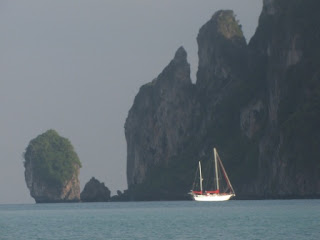
Most of us have heard of Phi Phi Island and Phi Phi Lay, those of us for sure anyway who have seen the movie The Beach. Ron visited there on his last Asian tour…20 odd years ago and needless to say, it has changed a bit. He remembers he felt disappointed because even back then (ahem) it seemed already well discovered (we all dream of being the first in an untouched land I think) and wished he had been there a few years earlier. Well, you can imagine what it is like now. Phi Phi Don, the island you actually stay on (Phi Phi Lay is a marine park and has no accommodation) is a jungle of resorts, shops, restaurants, tourists and partying backpackers. That being said, it is an excellent stop if you sleep in the right spot and get off the island in kayaks to explore the beaches. We never did make it to Phi Phi Lay because apparently it is combing with people by first thing and the illusion of a pristine deserted beach is inaccessible.

The interesting (or tragic) thing about Phi Phi is that it (and Phuket) lies in the eye of where the Tsunami hit on the Adman Coast in 2004. Landing at the Pier, you would never know the resort and beach had been absolutely devastated only 5 years ago. Yet there are photos and stories to prove it. We ate a number of times at a casual little spot called Samee’s. We never met Samee himself, but his delightful nephew Chilli was holding the fort providing amazing local fare and friendly conversation (and a few Thai cooking tips for Janet). Samee is incredibly thankful to be given a 2nd chance after being buried under a building in the Tsunami. He was rescued and an English friend has since helped him rebuild his life and start his restaurant. The walls are covered with graffiti from travelers who obviously love Samee and his food. He has huge sings up thanking the Tsunami, Buddha and his friends for helping him with his 2nd chance at life. We spent hours poring over his photo albums with images and stories from the Tsunami and we left our own signatures on his wall. As always, strength and positive things tend to eventually emerge from disaster. As for the bricks and mortar, they say there are more restrictions for building on Phi Phi since the Tsunami in the hopes to better control rapid tourist development but, it still seems incredibly crowded.

We were lucky to find reasonable accommodation right on the beach at a place called PP Sand Seaview Resort. It was so awesome to have a little bungalow right on the beach with a porch, sun chairs and umbrella right out front. The best part about this place was the 4 kittens hanging about to entertain us. The water off Phi Phi is really shallow so low tide is a bit of a bust for swimming. It’s best to catch a swim first thing in the morning then head off the island to other beaches for the rest of the day. Our only complaint about our bungalow was the 10 minute walk in the unbelievable heat to get anywhere and we could hear the thump of music well into the night from across the water. However, the 10 minute walk also meant we were out of the thick of things and had some space. Like I mentioned, Phi Phi is a party town and so perhaps we were the only people on the island going to bed by 10pm!!!

Our best decision on Phi Phi was to rent kayaks for a day. For about $15, we rented 2 double kayaks, masks and snorkels and headed out the northwest side of the island towards Monkey Beach. True to its name, the beach hosts were short, furry and liked to steal food. We headed from Monkey Beach across the bay to another beach with a quick stop at a shallow cave where we saw a reef shark swimming about under our kayaks. I don’t think Anna was too pleased to be hanging around above a shark, even a reef shark! And none of us took the opportunity to jump in and swim with our mask. Both Sadie and Anna I swear were born with gills, so the whole snorkeling thing was a great thing for both of them. And when the snorkeling was not great, we’d find fish with bits of fruit and entertain ourselves with the underwater camera.


We finally ended up on a beach on the west side of the northern long section of the island. It was horrible. We slowly paddled in looking at a deserted beach village on the right. We later found out this village is sometimes home to a group of sea gypsies who have since moved on to a new location. And the beach itself was ankle deep in ocean garbage, right up to the highest of high tide lines. Yuck, it was like standing in a Green Peace commercial. At first we were confused, was this garbage left over from the Tsunami but had never been cleaned up? We later found out, no…this is an annual deposit from winter seas and prevailing winds hitting the beach. Apparently, they clean it up by the time busy season starts – there is a 3 star resort only a 10 min. walk across the island to the other side. But honestly, I can’t imagine a clean-up that large and busy season was just days away. It was deserted except for a few long tail boats. The site of this garbage would make anyone stop the next time they even considered throwing a piece of garbage into the ocean or using plastic unnecessarily. We got out of our kayaks though because we needed a stretch and had heard there were cold drinks and food across the island. Our stomachs always win. We did find refreshment and a much nicer beach on the other side but didn’t stay long as we were afraid of arriving back to find our kayaks gone had we stayed away too long.

Us Gosneys were certainly enjoying our beach time. We managed to avoid getting burnt, got some math done, did lots of reading but were starting to melt a little from the heat and humidity. Janet was battling a terrible cold/flu and we were tired of cowering away from the heat. But the weather, as promised on or around November 1st was starting to change. The prevailing winds had swung around, the skies were becoming clearer, and there were no afternoon showers on our last 2 days there.